
Yogyakarta, on the Indonesian island of Java, doesn’t draw the same international name recognition as Bali, but it houses two of the most significant historical monuments in Southeast Asia and remains the seat of a living Javanese royal court — a combination that makes it arguably Indonesia’s most culturally rich destination.
Borobudur: The World’s Largest Buddhist Temple
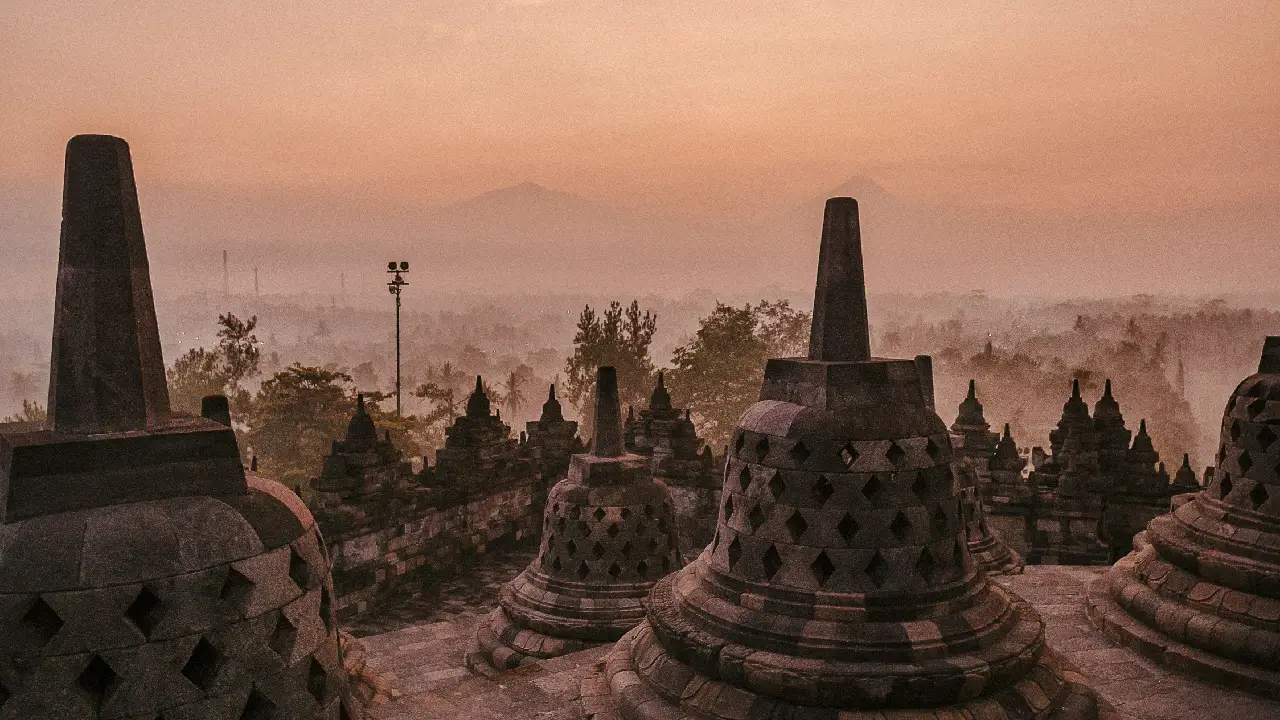
Borobudur, about an hour from Yogyakarta, is the largest Buddhist temple in the world, built in the 9th century by the Sailendra dynasty and rediscovered in the early 1800s after being buried under volcanic ash and jungle growth for centuries. The temple’s structure — a massive stepped pyramid decorated with over 2,600 relief panels depicting Buddhist teachings and over 500 Buddha statues — is designed as a physical representation of the path to enlightenment, meant to be walked in a specific circular route from base to summit.
Sunrise visits to Borobudur have become one of Indonesia’s signature travel experiences, with the temple’s silhouette rising above the morning mist and surrounding volcanoes, including the still-active Mount Merapi, visible in the distance on clear mornings. Sunrise tickets require separate, advance booking and command a premium price, but most visitors who’ve done it consider it well worth the cost and the pre-dawn wake-up call.
Prambanan: Java’s Hindu Masterpiece
Prambanan, on the opposite side of Yogyakarta from Borobudur, is the largest Hindu temple complex in Indonesia and one of the largest in Southeast Asia, built in the 9th century, roughly contemporaneous with Borobudur — a reflection of the religious diversity and tolerance that characterized ancient Javanese kingdoms. The complex’s towering central spires, dedicated to the Hindu trinity of Brahma, Vishnu, and Shiva, rise dramatically against the sky, and the site hosts regular performances of the Ramayana Ballet, a traditional dance retelling of the Hindu epic, staged against the illuminated temple backdrop after dark.
The Sultan’s Palace and Old City
Unlike most former royal courts in Southeast Asia, the Kraton (Sultan’s Palace) of Yogyakarta remains an active royal residence today, with the current Sultan serving simultaneously as the region’s governor — a unique arrangement within Indonesia’s otherwise republican government structure. Portions of the palace complex are open to visitors, showcasing Javanese architecture, gamelan orchestras, and royal artifacts, while providing insight into a court culture that continues, in modified form, into the present day.
Nearby, Taman Sari, the former royal garden complex, includes an elaborate bathing pool structure once used exclusively by the Sultan and his household, along with an underground mosque and a network of tunnels whose original purpose remains partially debated among historians.
Malioboro Street and Local Life
Malioboro Street, Yogyakarta’s main commercial artery, is the city’s best introduction to everyday Javanese street life — batik shops, street food vendors, horse-drawn carriages (andong), and pedicabs (becak) all share the street in a lively, chaotic mix. The street comes alive particularly in the evening, when lesehan-style street food stalls set up floor-level seating for casual open-air dining.
Practical Notes
Yogyakarta is well connected by both flights and an overnight train service from Jakarta, a popular and comfortable option for budget travelers. The city itself is compact and walkable, though Borobudur and Prambanan both require separate excursions outside the city center, easily arranged through hotels or independent drivers. The dry season (April-October) offers the clearest conditions for Borobudur sunrise visits, though the temple is worth visiting regardless of season if travel dates don’t align.