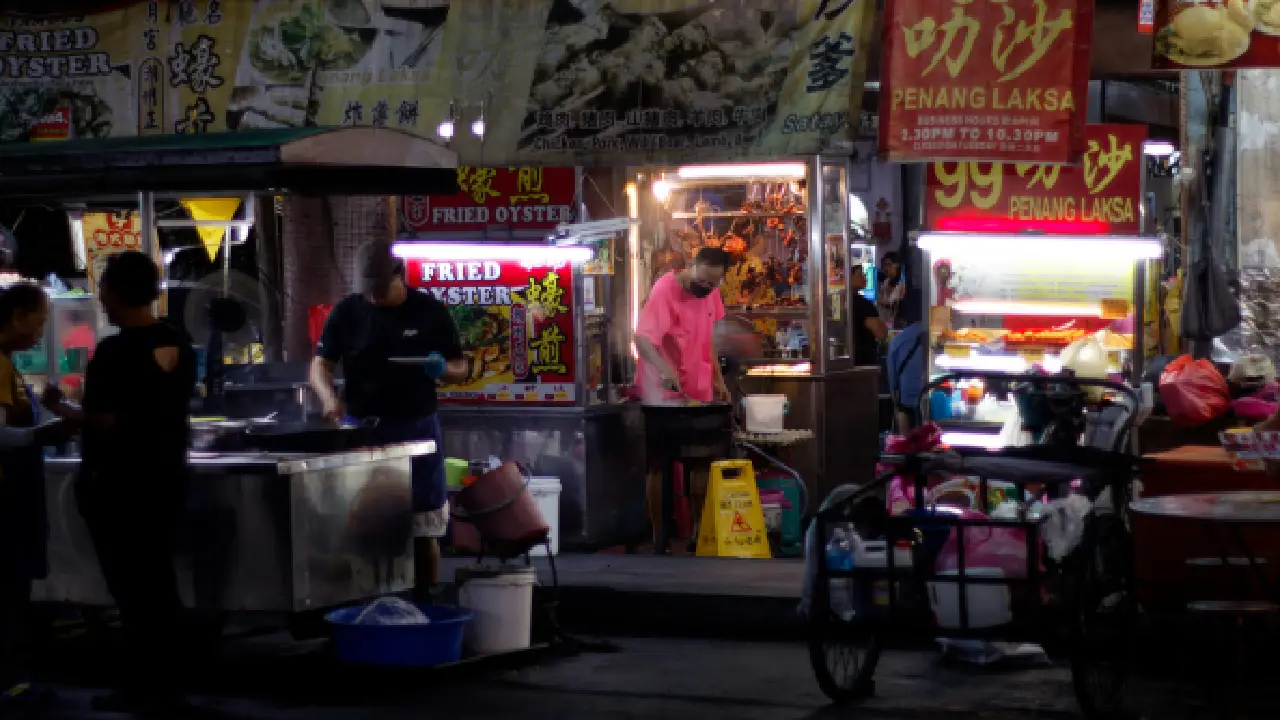

If Kuala Lumpur is Malaysia’s modern face, Penang — and specifically its capital, George Town — is where the country’s multicultural food and architectural heritage is most vividly on display. UNESCO recognized George Town as a World Heritage Site in 2008, citing its unique blend of colonial European, Chinese, and Malay architecture and culture, built up over more than 500 years as a major trading port.
George Town’s Historic Core
Walking through George Town’s historic center feels like moving through several distinct eras and cultures within a few blocks. Clan jetties — waterfront settlements built on stilts by Chinese immigrant clans in the 19th century, each housing a single extended family or clan group — remain inhabited today and are open for visitors to walk through, offering a rare living glimpse into a centuries-old immigrant community structure. Nearby, the Cheong Fatt Tze Mansion, an elegantly restored 19th-century Chinese courtyard house painted a distinctive indigo blue, offers guided tours through its Feng Shui-designed interior.
Street art has become one of George Town’s most photographed modern additions, particularly the murals by Lithuanian artist Ernest Zacharevic, whose playful, interactive pieces — including “Children on a Bicycle,” incorporating a real bicycle into the mural — are scattered throughout the old town and have become minor pilgrimage sites for visitors with cameras.
The Food: Why Penang Claims the Crown
Penang’s street food reputation is arguably the best in all of Malaysia, a product of the island’s deep Peranakan (Straits Chinese) heritage, blending Chinese, Malay, and Indian culinary traditions into dishes found nowhere else. Char kway teow — stir-fried flat rice noodles with prawns, egg, and bean sprouts, cooked over intensely high heat in a wok — reaches its most celebrated form here, with several hawker stalls having built multi-generational reputations around a single dish perfected over decades.
Assam laksa, a tangy, fish-based noodle soup distinct from the coconut-based laksa found elsewhere in Malaysia, is considered by many food writers to be Penang’s signature dish, and CNN once ranked it among the world’s most delicious foods. Gurney Drive and the New Lane hawker centers are the most accessible spots to sample a wide range of these dishes in one sitting, though the most devoted food travelers seek out standalone stalls that have earned cult followings for a single specialty.
Penang Hill and Kek Lok Si Temple
For a break from the historic core, Penang Hill offers a funicular railway ride up to cooler temperatures and views across the island and mainland — a popular spot for both sunrise and sunset given its clear vantage point. Nearby, Kek Lok Si Temple, the largest Buddhist temple in Malaysia, spans multiple levels up a hillside and includes a seven-story pagoda combining Chinese, Thai, and Burmese architectural styles, along with a towering bronze statue of Guan Yin, the Buddhist goddess of mercy.
Practical Notes
George Town is compact and best explored on foot, though the heat makes early morning or late afternoon walking more comfortable than midday. Renting a bicycle is also a popular way to cover more ground, particularly along the coastal roads outside the historic center. Penang is connected to mainland Malaysia via one of the longest bridges in Southeast Asia, and budget flights from Kuala Lumpur take under an hour, making it an easy add-on to a broader Malaysia itinerary.