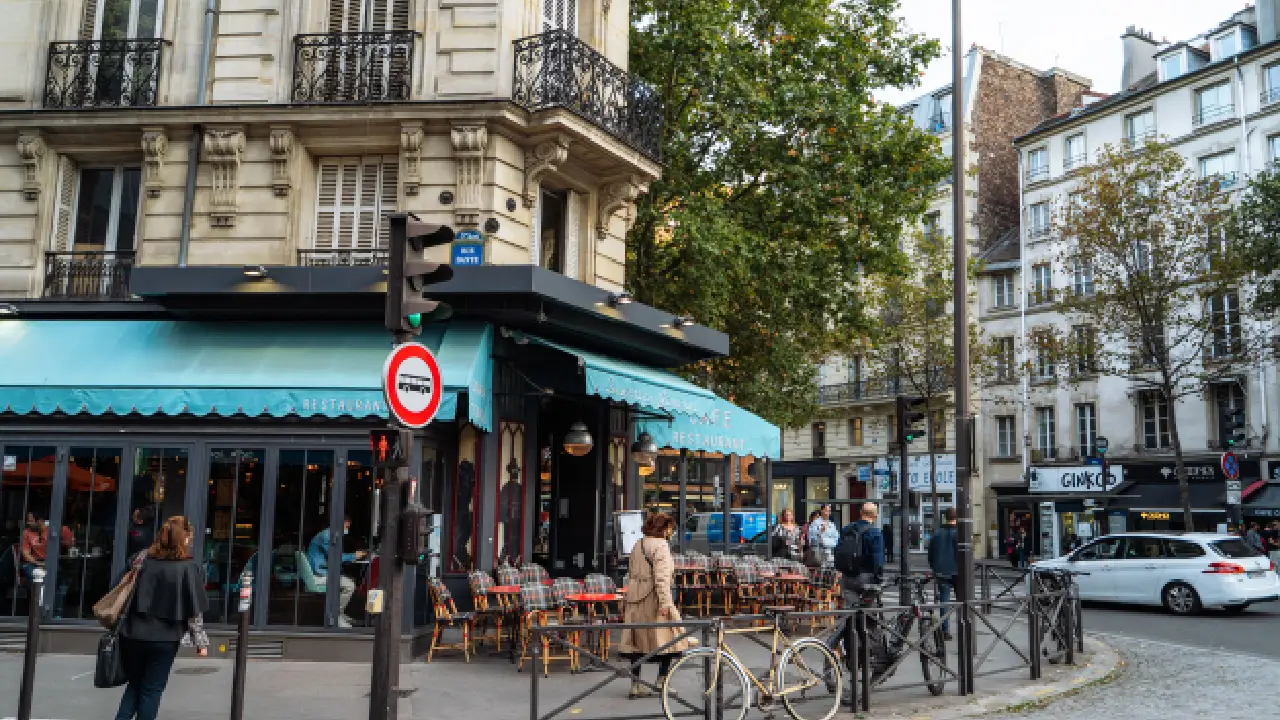

The Paris that seduces people into moving there isn’t the Eiffel Tower or the Louvre — it’s the neighborhoods where daily life happens: the markets, the corner cafes, the parks filled with locals rather than tourists. If you’ve already done the major landmarks, or simply want a more authentic taste of the city, these are the districts worth an unhurried afternoon.
Le Marais: History and Hipness Side by Side
Le Marais, spanning the 3rd and 4th arrondissements, is one of the few central Paris neighborhoods to survive Baron Haussmann’s 19th-century redesign of the city largely intact, which means its streets are narrower, older, and more architecturally varied than the grand boulevards elsewhere. It’s also home to the city’s historic Jewish quarter along Rue des Rosiers, where L’As du Fallafel draws long lines for what many consider Paris’s best falafel.
The neighborhood has become one of the city’s trendiest in recent decades, filled with independent boutiques, art galleries, and some of the best concept stores in Paris. Place des Vosges, the oldest planned square in the city (completed in 1612), is a quiet, arcaded green space perfect for a picnic away from crowds — Victor Hugo lived at number 6 for 16 years, and his former apartment is now a small, free museum.
Canal Saint-Martin: Parisian Life on the Water
Canal Saint-Martin, in the 10th arrondissement, feels miles away from the tourist center despite being a short metro ride from it. Built in the early 1800s to supply Paris with fresh water and reduce disease, the canal today is lined with cafes, independent bookshops, and iron footbridges where locals gather in the evening with bottles of wine bought from a nearby shop.
This is the neighborhood to see how young Parisians actually spend their weekends — picnicking canal-side, browsing vintage clothing shops on Rue de Marseille, or catching a film at one of the area’s independent cinemas. It’s less about specific sights and more about the atmosphere of unhurried Parisian life.
Belleville: Paris’s Most Diverse Neighborhood
Belleville, in the northeast of the city, has historically been home to waves of immigrants — Chinese, North African, and Eastern European communities have all left their mark on the neighborhood, making it one of the most culturally diverse and least touristy parts of central Paris. Parc de Belleville offers one of the best (and least crowded) panoramic views of the city, arguably rivaling Montmartre’s Sacré-Cœur viewpoint without the crowds.
The neighborhood is also increasingly known for street art — informal murals cover walls throughout the area — and for some of the city’s most affordable, authentic ethnic food, from Vietnamese pho to Algerian pastries.
Saint-Germain-des-Prés: Literary Paris
Saint-Germain-des-Prés, on the Left Bank, was the intellectual heart of mid-20th-century Paris, where Jean-Paul Sartre, Simone de Beauvoir, and other existentialist writers debated for hours at cafes like Les Deux Magots and Café de Flore. Both cafes still operate and, while now firmly on the tourist trail (and priced accordingly), remain worth a coffee for the atmosphere and history alone.
The neighborhood’s real charm, though, is in its side streets — small art galleries, antique shops, and the Luxembourg Gardens nearby, one of the most beautiful and popular green spaces in the city, particularly around the octagonal pond where children have sailed toy boats for generations.
Practical Notes
These neighborhoods are best explored on foot or by bike (Paris’s Vélib bike-share system covers all of them) rather than by metro, since much of their appeal lies in the small details you’d miss underground. Weekday mornings tend to be quieter than weekends, when Canal Saint-Martin especially gets crowded with locals enjoying their day off.