
Munich has a reputation problem — most visitors know it only as “the Oktoberfest city,” which sells short one of Germany’s most livable, architecturally rich, and genuinely fun capitals. Bavaria’s capital deserves at least three days of exploration, whether or not you’re visiting during the famous festival.
The Historic Core
Begin at Marienplatz, Munich’s central square, dominated by the neo-Gothic Neues Rathaus (New Town Hall). At 11am, noon, and (in summer) 5pm, the Glockenspiel in the tower’s facade puts on a mechanical show with 43 bells and 32 life-sized figures reenacting a 16th-century royal wedding and a coopers’ dance — a tradition supposedly linked to warding off the plague.
From Marienplatz, it’s a short walk to the Viktualienmarkt, a permanent open-air food market that’s been operating since 1807. Grab a Weisswurst (Bavarian white sausage, traditionally eaten before noon with sweet mustard and a pretzel) from one of the stalls and eat standing at one of the market’s beer garden tables.
Museums and Palaces
Munich has one of the finest art museum districts in Europe, the Kunstareal, anchored by the Alte Pinakothek (Old Masters), Neue Pinakothek (19th-century art), and Pinakothek der Moderne (contemporary art and design). If you only visit one, the Alte Pinakothek’s collection of Dürer, Rubens, and Rembrandt rivals anything in Paris or Amsterdam.
For a change of pace, take the tram out to Nymphenburg Palace, the sprawling summer residence of Bavarian royalty. Unlike Neuschwanstein’s fairy-tale theatrics, Nymphenburg is a study in restrained Baroque grandeur, surrounded by formal gardens and canals that are free to walk even if you skip the palace interior.
Oktoberfest, Done Right
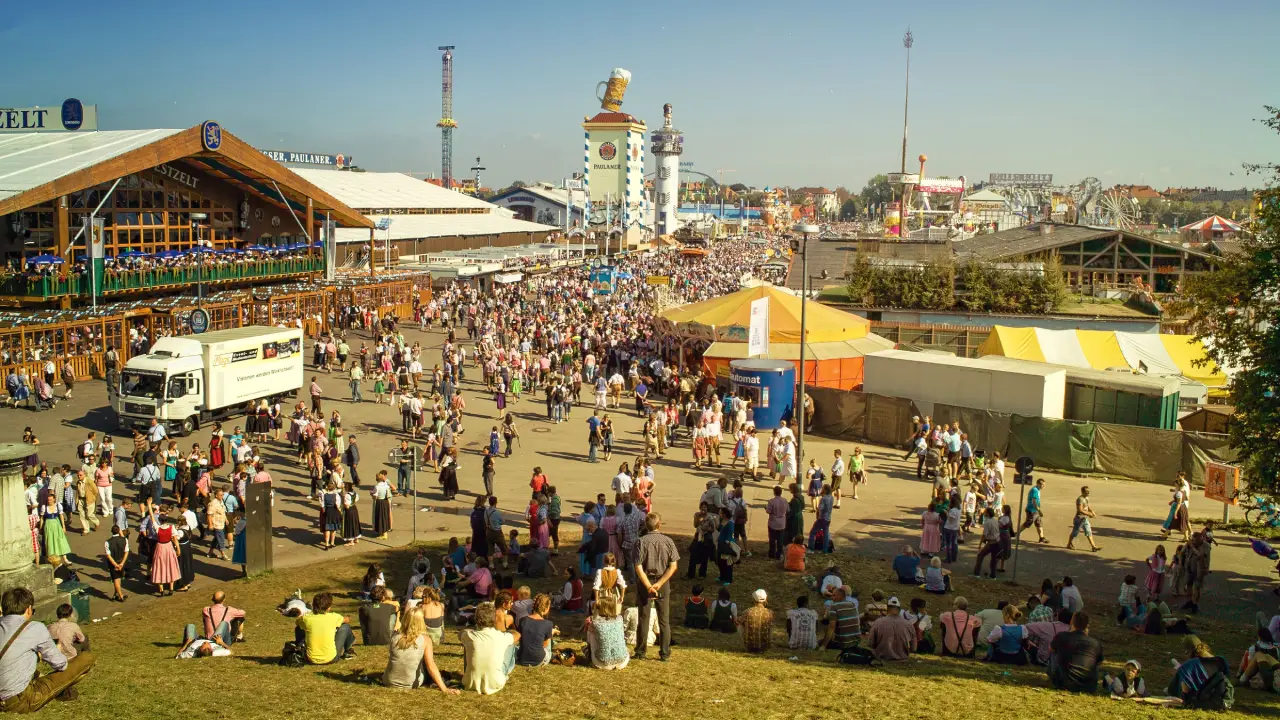
If you’re visiting during Oktoberfest (typically mid-September through the first Sunday in October), know that it’s far bigger and more chaotic than most first-timers expect — over six million visitors pass through the Theresienwiese grounds each year. The festival is organized around massive beer tents run by Munich’s major breweries (Hofbräu, Augustiner, Paulaner, among others), each with its own atmosphere; Augustiner’s tent tends to draw more locals, while Hofbräu’s is the rowdiest and most tourist-heavy.
Arrive early (before 10am on weekends) if you want a seat without a reservation, since tents fill up fast and standing room isn’t always guaranteed. Wearing traditional Bavarian dress — lederhosen for men, dirndls for women — isn’t required, but the vast majority of attendees do it, and rental shops throughout the city make it easy to join in.
Beyond the Tents: A City for Every Season
Outside festival season, Munich’s real charm shows in its everyday rhythms — locals surfing a standing river wave on the Eisbach in the English Garden, families picnicking in the massive park (larger than New York’s Central Park), and the year-round beer garden culture that doesn’t need a festival as an excuse. The Chinese Tower beer garden in the English Garden seats 7,000 people under chestnut trees and is a genuine local institution, not a tourist trap.
Munich also makes an excellent base for day trips — the Alps are less than an hour away by train, and Dachau Memorial Site, an essential if sobering visit to the first Nazi concentration camp, is a 30-minute S-Bahn ride from the city center.
Practical Notes
Munich is one of Germany’s more expensive cities, particularly during Oktoberfest when hotel prices can triple. Book accommodation months in advance if traveling in September. The city’s public transport system, the MVV, is efficient and covers the airport, city center, and surrounding countryside on a single ticket system.